
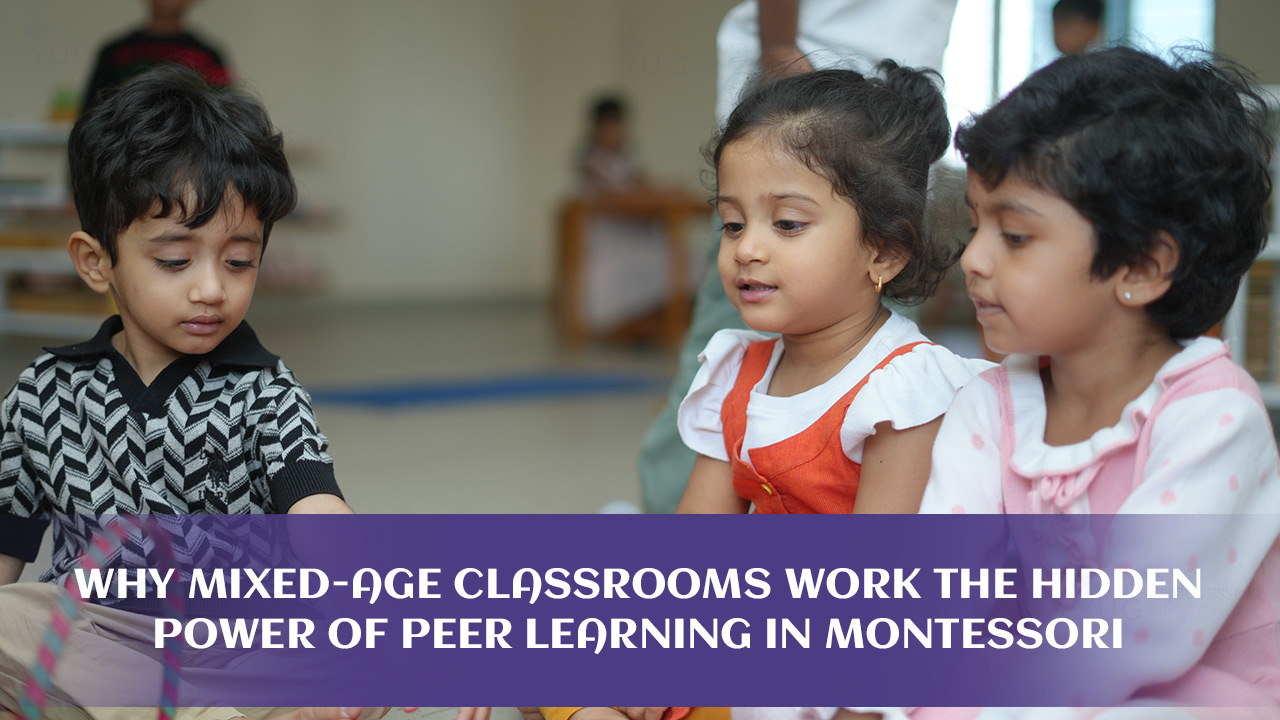
One of the most distinctive and most misunderstood features of a Montessori classroom is that children of different ages learn side by side. Here is why that is not just acceptable, but genuinely brilliant.
When parents visit Yug Montessori in LB Nagar, Hyderabad for the first time, one question comes up almost every single time: "Why are children of different ages in the same classroom?"
It is a fair question. Most of us grew up in grade-based schools where every child in the room was born within twelve months of each other. So when parents see a four-year-old working quietly alongside a six-year-old, it can feel unusual even a little concerning.
But the mixed-age Montessori classroom is not an accident or a compromise. It is one of the most intentional and research-backed aspects of Montessori education. And for families exploring the best preschool in LB Nagar, understanding this feature often becomes the moment everything clicks.
Dr. Montessori's Original Insight Children Learn From Each Other
Dr. Maria Montessori observed something that many educators before her had overlooked: children don't just learn from adults. They learn powerfully, naturally, and joyfully from each other.
She grouped children in three-year age bands typically 2 to 3 years for toddlers, and 3 to 6 years for the primary level because this range created a living, breathing learning community. Within these groups, children were not waiting for a teacher to instruct them. They were teaching, observing, leading, and following often all in the same afternoon.
"In our schools, the children of different ages help one another. The younger ones see what the older ones are doing and ask for explanations. These are given spontaneously, and the instruction is far more valuable than that given by a teacher." Dr. Maria Montessori
This insight is at the heart of Montessori peer learning and one of the defining features of the Montessori method that sets it apart from any conventional play school in Hyderabad or grade-based classroom.
Three Roles Every Child Plays in a Mixed-Age Montessori Classroom
What makes the mixed age group learning model so effective is that every child moves through three distinct roles over their three years in the programme and each role shapes them in a profoundly different way.
The Youngest Learning Through Observation
As the youngest, a child enters a world already in motion. They learn by watching, absorbing the rhythms of the classroom, the behaviour of older peers, the materials they haven't yet been introduced to.
This is not passive learning. It is the same kind of deep, curious observation that drives all early childhood development. The youngest child is constantly asking: How does this work? What will I be able to do? and finding the answer simply by being present in the room.
The Middle Years Building Learning Confidence
In the middle years, a child begins to consolidate what they know. They are no longer the newest in the room, but not yet the most experienced. They see both directions looking up at what is coming and back at where they started.
This perspective builds a kind of learning confidence that is extremely difficult to teach directly. It is one of the most underappreciated benefits of Montessori education and a key reason why child development stages unfold so naturally in a Montessori environment.
The Oldest Teaching Deepens Understanding
As the oldest, a child becomes a guide. They explain, they demonstrate, they help. And in doing so, they deepen their own understanding in ways that formal instruction rarely achieves.
There is a well-established concept in education research called the protégé effect: when we teach something to someone else, we understand it more completely ourselves. In a traditional classroom, only the teacher experiences this. In a Montessori primary programme, every child does repeatedly, naturally, every day.
This is peer learning in early childhood at its most powerful and it is a lived reality for every child at Yug Montessori LB Nagar.
Mixed-Age Classrooms Remove the Anxiety of Comparison
One of the quietest and most powerful gifts of the mixed-age Montessori classroom is what it eliminates: the pressure of being compared to children of the exact same age.
In a single-age classroom, if a child needs more time with a concept, it shows. The child beside them has moved on. This creates a quiet but persistent story: "I am behind." That story, once formed early, can follow a child for years.
In a Montessori classroom, there is no "behind." A four-year-old working on something most four-year-olds haven't started yet simply looks like a four-year-old working which is exactly what they are.
Every Child Moves at Their Own Pace
Development unfolds at each child's own pace, supported by a trained Montessori guide teacher who observes closely and introduces new challenges only when the child is genuinely ready.
This is a fundamental distinction between Montessori vs traditional school environments and one of the primary reasons parents across Hyderabad and LB Nagar who are comparing preschool admissions in Hyderabad consistently choose the Montessori path.
How Mixed-Age Classrooms Build Real Social Intelligence
Patience, Respect, and Responsibility
Children learn patience with those who know less. They learn respect for those who know more. They learn that being the youngest is temporary and that being the oldest comes with real responsibility.
These are not lessons from a curriculum card or a circle-time discussion. They are lived, daily, through real interactions. This is social development in children at its most authentic and it produces a quality of social intelligence in children that parents most often comment on when reflecting on their child's time at a Montessori school.
Leading and Following A Life Skill Learned Early
The social maturity that Montessori children develop the ease with which they move between leading and following, helping and asking for help is one of the most remarkable outcomes of the multi-age classroom model.
It is also one of the clearest expressions of Montessori philosophy: that education is not just preparation for academic life, but for life itself. This is what parents searching for genuinely child-led learning in a toddler school in LB Nagar are really looking for even if they don't yet have the words for it.
What Mixed-Age Learning Looks Like at Yug Montessori, LB Nagar
In our Primary programme, children aged 3 to 6 share a thoughtfully prepared environment right here in LB Nagar, Hyderabad.
Over three years, your child's journey unfolds in three beautiful stages:
Year One Arriving and Absorbing
Your child arrives as the newest member of the community watching, absorbing, settling in. They are surrounded by children who already know the rhythms of the classroom, and they learn simply by being present. This immersion mirrors the natural way that Montessori for toddlers learning happens through the Absorbent Mind, not through instruction.
Year Two Working and Belonging
By the middle year, your child is working confidently with materials and forming genuine friendships across ages. They know the classroom, they know their community, and they carry a quiet confidence that comes from having found their place.
Year Three Leading and Growing
By the time they are among the oldest, they are leading younger children with a quiet pride that no certificate or grade could produce. They are not just learners, they are contributors to the community around them.
Each stage of this journey is a stage of growth not just academically, but as a human being learning how to be in community with others. That is what Montessori education means when it calls itself education for life.
Answering Common Parent Concerns About Mixed-Age Classrooms
It is completely natural to wonder whether your child will receive enough individual attention in a mixed-age group or whether younger children might slow down older ones, or overwhelm those who are newest to the classroom.
Every Child Works at Their Own Level
The answer lies in the design of the Montessori prepared environment itself. Every child works with materials matched to their individual readiness, not the group's average. The Montessori guide observes each child carefully and introduces new work based on that child's unique development.
Community, Not Chaos
The mixed-age setting does not mean children are left to manage on their own. It means they are held within a rich, diverse learning community, with a skilled adult who knows each child's journey intimately.
That combination of individual pace within a caring, multi-age community is what makes the Montessori classroom unlike anything else in early childhood education in Hyderabad. It is why families who are looking for the best Montessori school in LB Nagar consistently find that Yug Montessori's approach to mixed-age learning is one of the things they value most.
Is a Mixed-Age Montessori School Right for Your Child in LB Nagar?
If you are a parent in LB Nagar, Hyderabad exploring preschool admission in LB Nagar or trying to decide between a conventional play school in LB Nagar and a Montessori environment, the mixed-age classroom is worth understanding deeply because it reflects something important about how children actually grow.
Children do not develop in neat, age-sorted batches. They develop in community, through relationship, through watching and doing and teaching. The Montessori method simply builds a school around that truth rather than asking children to fit a structure that was never designed with them in mind.
Whether you are searching for a nursery school in LB Nagar, a playgroup in LB Nagar](interlink: playgroup-lb-nagar), or a full [Montessori preschool in LB Nagar, Hyderabad](interlink: montessori-preschool-lb-nagar) we invite you to visit Yug Montessori and see the mixed-age community in action.
Once you watch a six-year-old gently guide a three-year-old through their first lesson with a material with patience, pride, and genuine care the question of "why different ages?" tends to answer itself.
The Mixed-Age Classroom A Foundation Built for Life
At Yug Montessori, LB Nagar, the mixed-age classroom is not a logistical choice. It is a philosophical commitment to how children learn best.
It is a commitment to letting every child be the youngest, the middle, and the oldest. To letting every child experience the full arc of a learning community. To building not just capable students but capable, compassionate human beings.
This is what the best preschool in Hyderabad looks like when it is truly built around the child and it is what awaits your child at Yug Montessori, LB Nagar, Hyderabad.