
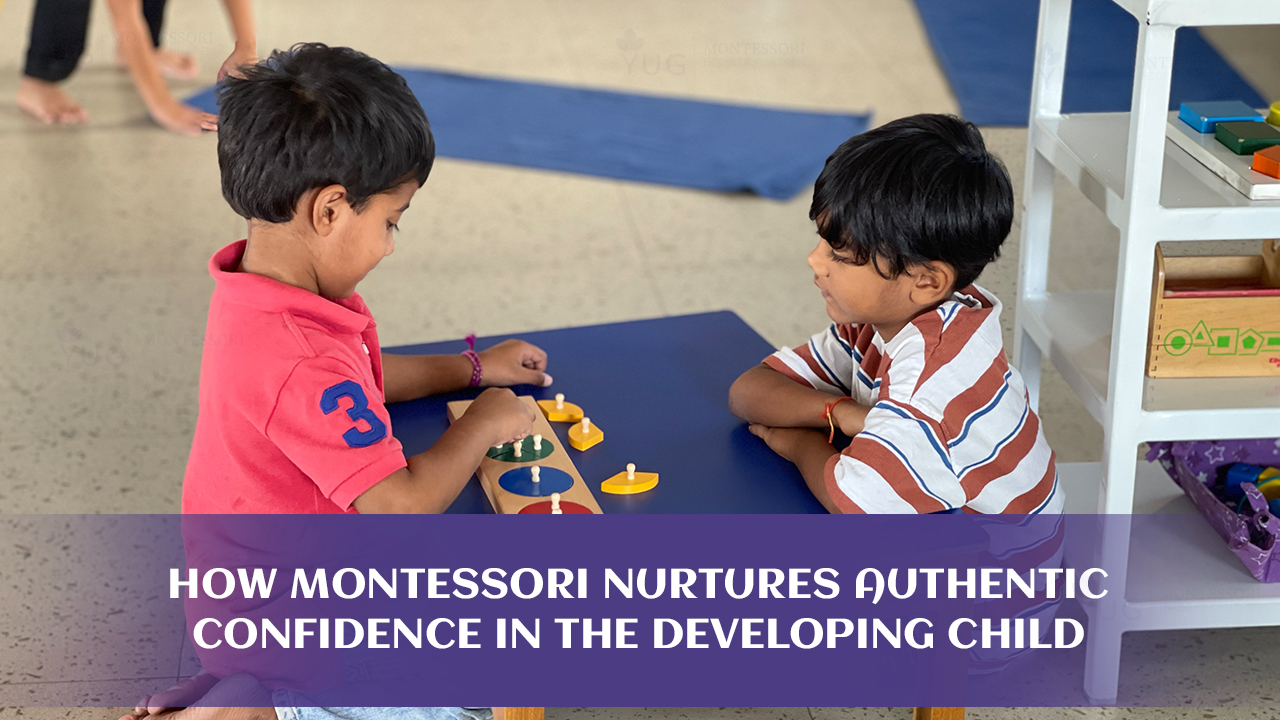
Confidence is not a trait that can be handed to a child through praise or reward charts. It is something far more organic — something that takes root quietly, through daily encounters with meaningful work, independent choice, and environments designed to honour a child's natural rhythm of growth.
When parents visit Yug Montessori in LB Nagar, Hyderabad, they often notice something different in the children here. There is a quiet assurance in the way they move through the classroom, choose their work, and engage with challenges without looking for approval. That quality is not a coincidence. It is the result of an approach to early childhood education that has been cultivating authentic confidence in children for over a century.
In Montessori philosophy, confidence is not a goal to be achieved at the end of a lesson. It is a living quality that emerges when children are trusted to engage genuinely with the world around them. For families exploring the best preschool in LB Nagar, understanding how that confidence is built often becomes the moment everything clicks.
The Prepared Environment as a Foundation for Self-Trust
Dr. Maria Montessori observed that children carry within them an inner drive that propels them toward purposeful activity. When a Montessori classroom is thoughtfully arranged to respond to this inner energy, children naturally move toward independence. The prepared environment is not merely a physical space. It is an ecosystem calibrated to the developmental needs of the child — scaled furniture, accessible materials, uninterrupted work cycles, and an atmosphere of calm intentionality.
Within this space, children exercise what Montessori philosophy describes as freedom within structure. They select their work from open shelves, determine the pace of their engagement, and choose where within the environment they wish to work. These are not trivial decisions. Each choice is, in essence, a quiet act of self-affirmation.
Every Choice Is a Building Block
The child who selects a work, carries it to their mat, and concentrates on it without prompting is discovering something foundational: I am capable of directing myself.
This self-directed learning, repeated across hundreds of daily interactions, is precisely where authentic confidence is constructed — not through adult validation, but through direct experience. This is a fundamental distinction between Montessori and conventional early learning environments, and one of the primary reasons parents across Hyderabad and LB Nagar who are comparing preschool admissions consistently choose the Montessori path.
Practical Life: Where Confidence Meets Purposeful Action
Among all areas of the Montessori curriculum, Practical Life activities occupy a particularly significant place in the development of the whole child. Activities such as pouring, transferring, folding, lacing, polishing, food preparation, and care of the environment are far more than exercises in fine motor coordination. They are invitations for the child to participate in real, meaningful work — the kind of work they observe adults engaging in every day.
When a three-year-old pours water from a small pitcher into a glass without spilling, or carefully arranges flowers in a vase as part of their morning routine, something important is happening beneath the surface. The child is not simply practising a skill. They are building an internal narrative: I contribute. I belong here. I can do this.
Normalisation: The Natural State of a Confident Child
Montessori called this process normalisation — through which a child, through concentrated, purposeful work, finds their natural equilibrium. A normalised child is not passive or compliant. They are focused, joyful, and deeply self-assured. Practical Life activities are among the most direct pathways to that state.
Building the Will Through Repetition
When a child chooses to repeat a transferring exercise fifteen times — not because they were asked to, but because something within them is not yet satisfied — they are practising persistence, self-regulation, and intrinsic motivation. These qualities form the bedrock of lasting child confidence. This is what parents searching for genuinely child-led learning in a toddler school in LB Nagar are really looking for, even if they don't yet have the words for it.
Montessori Materials and the Power of Self-Correction
One of the most distinguishing features of authentic Montessori materials is what is known as the control of error. Rather than relying on an adult to confirm whether a response is right or wrong, the material itself provides feedback. The knobbed cylinders in the Sensorial area, for instance, will not all fit correctly unless the child has placed each one in its corresponding socket. The golden bead material in Mathematics communicates quantity through direct sensory experience, not abstract explanation.
Error as Information, Not Failure
In many conventional early learning settings, the child's relationship with error is entangled with adult judgement. Mistakes become associated with correction from outside — a mark on the page, a redirect from the teacher. Over time, this dynamic can cultivate caution, performance anxiety, and a fear of trying.
In contrast, Montessori materials teach the child to regard error as information rather than failure. The child who notices a mismatch in their work simply tries again. There is no shame attached. There is only observation, adjustment, and renewed effort.
A Growth Mindset Built Through the Hands
This is the scaffolding of a growth mindset for kids, built not through motivational language, but through the material reality of the child's daily work. The child confidence that emerges from this process is authentic — earned through the child's own hands, eyes, and effort. It is one of the clearest expressions of Montessori philosophy and one of the defining features of the best Montessori school in LB Nagar.
The Guide's Role: Observing, Not Directing
In a Montessori classroom, the adult is intentionally repositioned. Rather than standing at the centre of learning as the primary source of knowledge, the Montessori guide moves through the environment as a careful observer, an inviter, and a connector between the child and the appropriate material at the appropriate moment.
Honouring Sensitive Periods
This role requires deep familiarity with child development, including an understanding of sensitive periods — those windows of heightened receptivity during which the child shows particular readiness for certain learning experiences. A child in a sensitive period for order, for instance, may become absorbed in categorising and sequencing materials in ways that appear repetitive to the outside observer. The attuned guide recognises this not as distraction, but as the child doing exactly the inner work they need to do.
Trust as the Greatest Teacher
By honouring these sensitive periods and resisting the impulse to intervene unnecessarily, the guide communicates something powerful: You are trusted.
Children who feel genuinely seen and trusted become willing to take intellectual and social risks — to attempt difficult work, to ask questions openly, and to engage with the unfamiliar without retreating into anxiety. This quality of trust is at the heart of what makes a Montessori school in LB Nagar genuinely different from any conventional play school in LB Nagar.
The Mixed-Age Community and Social Confidence
Montessori education typically groups children across a three-year age span. This structure, so different from conventional grade-based systems, creates a dynamic community in which child confidence develops through relationship as much as through individual work.
Younger children absorb the behaviours and capabilities of older peers through observation — a process Montessori described as learning through the Absorbent Mind. Older children, in turn, consolidate their own understanding by guiding and supporting those younger than themselves. This mentoring dynamic cultivates empathy, communication, and a genuine sense of social responsibility.
No Comparison, No Competition
There is no competitive grading within this community. Children are not ranked against one another. Progress is recognised individually, in relation to each child's own developmental continuum. Within such an environment, child confidence is not built at anyone else's expense. It arises collaboratively, within a culture of mutual respect.
This is what child development in Montessori looks like when it is truly built around the child — and it is what awaits your child at Yug Montessori, LB Nagar, Hyderabad.
What Confidence Building Looks Like at Yug Montessori, LB Nagar
In our Primary programme, children aged 3 to 6 share a thoughtfully prepared environment right here in LB Nagar, Hyderabad. Over three years, the journey of confidence unfolds in three beautiful stages.
Year One: Arriving and Discovering
Your child arrives and begins to discover what they are capable of. Through Practical Life activities and sensorial exploration, they encounter work that is real, purposeful, and within their reach. Every small success quietly tells them: I can do this.
Year Two: Working and Growing
By the middle year, your child is working with independence and genuine focus. They are no longer new to the environment. They know the rhythms, the Montessori materials, and themselves a little better. The confidence that has been building beneath the surface begins to show.
Year Three: Leading and Contributing
By the time they are among the oldest, they are guiding younger children, taking on real responsibility, and carrying themselves with a quiet self-assurance that no grade or certificate could produce. They are not just learners. They are contributors to the community around them.
Each stage of this journey is a stage of growth — not just academically, but as a human being learning how to trust themselves. That is what Montessori education means when it calls itself education for life.
Answering Common Parent Concerns About Confidence in Montessori
It is completely natural to wonder whether a child will truly build child confidence without regular praise, gold stars, or external reward systems. Many parents, especially those who grew up in conventional schools, find this one of the most surprising aspects of the Montessori method.
Why Praise Is Not the Answer
Research in child development consistently shows that external praise — particularly praise tied to outcomes rather than effort — can actually undermine a child's confidence over time. Children who are told 'you are so smart' become reluctant to try things they might fail at. Children who are given the space to struggle, self-correct, and succeed on their own terms develop a far more durable sense of capability.
Real Confidence Comes From Real Work
At Yug Montessori, confidence is not something we give children. It is something they build themselves — through the Montessori materials, through the prepared environment, through the daily experience of being trusted and capable. That is what families exploring early childhood education in LB Nagar find when they visit us: children who are not performing confidence, but living it.
Is a Montessori School Right for Your Child in LB Nagar?
If you are a parent in LB Nagar, Hyderabad exploring preschool admission in LB Nagar or trying to decide between a conventional play school in LB Nagar and a Montessori environment, the question of confidence is worth understanding deeply — because it reflects something important about how children actually grow.
Children do not build lasting child confidence through praise, reward charts, or competition. They build it through meaningful work, genuine independence, and environments that trust them to figure things out. The Montessori method simply builds a school around that truth rather than asking children to fit a structure that was never designed with them in mind.
Whether you are searching for a nursery school in LB Nagar, a playgroup in LB Nagar, or a full Montessori preschool in LB Nagar, Hyderabad — we invite you to visit Yug Montessori and see what authentic confidence looks like in a child who has been given the space to grow.
Once you watch a child work through a challenge on their own, self-correct without being told, and look up with quiet satisfaction — the question of how child confidence is built tends to answer itself.
Authentic Confidence: A Foundation Built for Life
At Yug Montessori, LB Nagar, confidence is not a programme or a goal. It is a natural outcome of how children spend their days — trusted with real work, supported without being rescued, and welcomed into a community where they are known and respected.
It is a commitment to letting every child discover, at their own pace, that they are capable. That they belong. That they can.
This is what the best preschool in Hyderabad looks like when it is truly built around the child — and it is what awaits your child at Yug Montessori, LB Nagar, Hyderabad.