
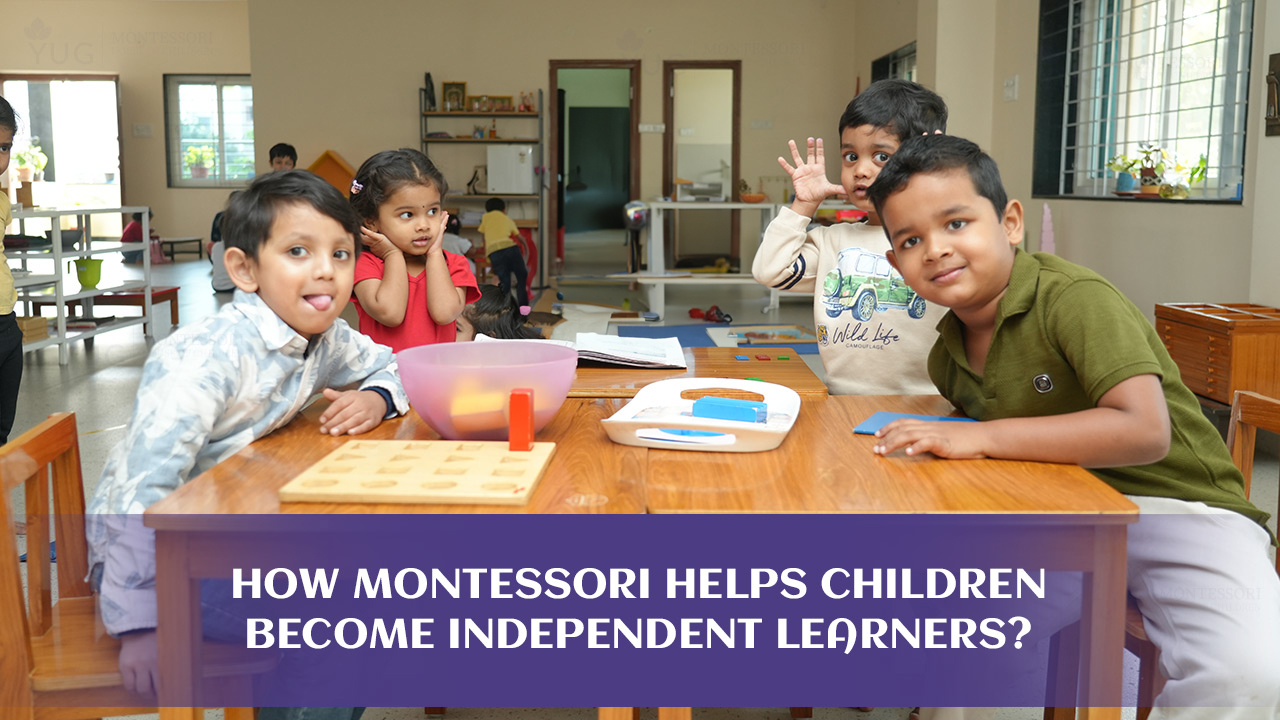
Independence in a child does not appear overnight. It is not taught through instructions or expectations. It grows quietly when a child is trusted, respected, and given the right environment to explore at their own pace. Montessori education is built around this understanding of childhood.
The Montessori concept of learning believes that the child has the capability of three powers based on the child’s understanding—sensitive periods, absorbent mind, and the need for adaptability. Based on these powers, the child is carved to become an independent learner.
At Yug Montessori, independence is not a goal for the future. It is something children experience every day, in small, meaningful ways, from the moment they enter the environment.
Independence Begins with Respect for the Child
Montessori education is rooted in deep respect for the child as an individual. Each child arrives with their own rhythm, interests, and readiness. Instead of directing every step, the Montessori approach observes carefully and responds thoughtfully.
This philosophy was shaped by Dr.Maria Montessori, who believed that children naturally strive toward independence when given freedom within clear limits. When adults step back and trust this process, children begin to discover what they are capable of doing on their own.
This respect builds confidence. A child who feels trusted begins to trust themselves.
The Prepared Environment Supports Independent Choice
The Montessori classroom is known for the prepared environment for each student based on their need and understanding. Everything within it is intentional. Materials are placed on low shelves, accessible to small hands. Furniture is child-sized. Each activity has a clear place and purpose.
In this environment, children are free to choose their work. This choice is not random. It is guided by inner readiness and interest. When a child selects their own activity, they become deeply engaged. They are not working to please an adult. They are working for themselves.
This simple act of choosing builds decision-making skills and responsibility. Over time, children learn to plan their work, carry it out, and return materials independently. These daily experiences form the foundation of independent learning.
Learning Through Hands and Movement
Montessori learning is rooted in movement. Children learn by doing, touching, carrying, pouring, sorting, and arranging. The hands are the pathway to the mind.
Montessori materials are self-correcting. This means the child can recognize and adjust their own errors without adult intervention. When a child notices a mistake and corrects it independently, learning becomes deeper and more meaningful.
This process strengthens concentration and perseverance. Children learn that effort leads to understanding. They experience satisfaction that comes from mastering a task on their own, rather than seeking approval.
The Role of Practical Life in Building Independence
Practical Life activities are at the heart of Montessori education. These activities include caring for the environment, caring for oneself, and practicing coordinated movement. Pouring water, buttoning frames, sweeping, folding, and food preparation are all part of this area.
To an adult, these may seem simple. To a child, they are powerful tools for development. Through Practical Life, children refine movement, develop order, and gain control over their actions.
More importantly, they learn that they are capable. When a child pours water without spilling, ties their own laces, or cleans a workspace independently, their sense of self grows. These moments quietly say, “I can do it myself.”
This inner confidence carries into every other area of learning.
Independence Within a Clear Structure
Freedom in Montessori is always paired with responsibility. Children are free to choose their work, but they are also responsible for completing it with care. They learn to respect materials, the environment, and the work of others.
The uninterrupted work cycle allows children to stay with an activity for as long as they need. This protected time supports deep concentration and focus. Over time, children learn to manage their time, persist through challenges, and complete tasks independently.
This structure provides security. Children know what is expected, and within that clarity, they grow confident in their choices.
The Guide as an Observer and Supporter
In Montessori, the adult is referred to as the guide. The role of the guide is not to lead the child but to support their natural development. The guide observes carefully, offers lessons when the child is ready, and steps back to allow independent exploration.
By not interrupting unnecessarily, the guide allows children to experience struggle, repetition, and success. This space is essential. It teaches patience, resilience, and trust in one’s abilities.
Children learn that help is available when needed, but they are also encouraged to try first. This balance nurtures independence without pressure.
Mixed-Age Classrooms Encourage Growth
Montessori classrooms are mixed-age environments. Younger children observe older children working with focus and confidence. Older children naturally take on leadership roles, offering gentle guidance and modeling independence.
This dynamic supports social development and empathy. Children learn from one another, not through competition, but through cooperation and respect.
In this setting, independence grows naturally. Each child moves forward at their own pace, inspired rather than compared.
Independence Beyond the Classroom
The independence nurtured in Montessori extends far beyond academic learning. Children develop the ability to care for themselves, make thoughtful choices, and approach challenges with confidence.
They learn to trust their judgment, manage emotions, and take responsibility for their actions. These skills form the foundation for lifelong learning and personal growth.
Rather than depending on constant direction, Montessori children develop inner motivation. They learn because they are curious, not because they are told to learn.
A Foundation for Life
At Yug Montessori, independence is not rushed or forced. It is gently cultivated through daily experiences, meaningful work, and respectful relationships.
When children are given the time and space to grow, they become capable, confident learners. They carry with them a quiet strength, a love for learning, and the belief that they are capable of navigating the world around them.
This is the true gift of Montessori education. Not just prepared students, but prepared human beings.