
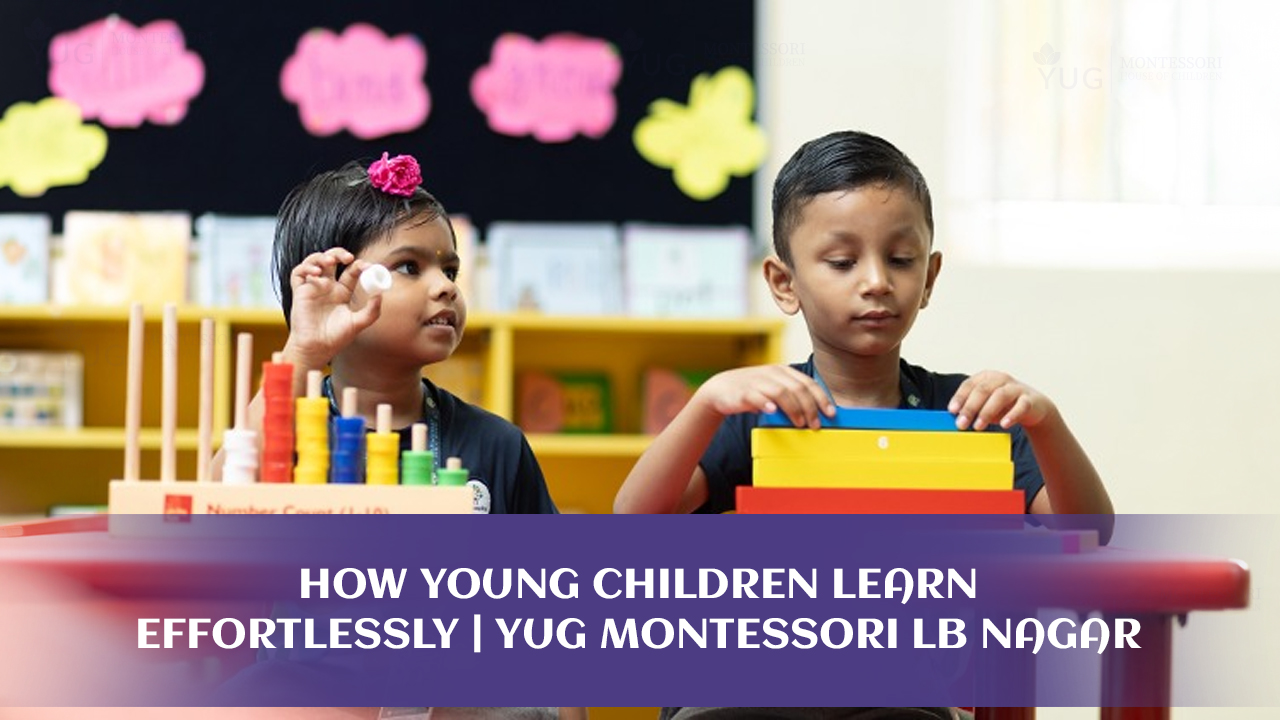
"The child has a different relation to his environment from ours… the child absorbs it. The things he sees are not just remembered; they form part of his soul." Dr. Maria Montessori
Have you ever watched a two-year-old pick up the rhythm of a new song after hearing it only once? Or noticed how your child has quietly adopted the way you fold a cloth, pour a glass of water, or greet a neighbour without you ever sitting down to teach them?
These moments feel almost magical. But there is a very real explanation behind them, one that lies at the very heart of Montessori philosophy, the concept of the Absorbent Mind.
At Yug Montessori, one of the best preschools in LB Nagar this principle is not just something we teach. It is the foundation of how we design every classroom, every material, and every moment in the child's day.
What Is the Absorbent Mind in Montessori Education?
Dr. Maria Montessori spent decades observing children across cultures and backgrounds. One of her most enduring discoveries was this: young children do not learn the way adults do.
Adults approach new knowledge deliberately. We compare, evaluate, and consciously decide what to hold onto. A child in the early years does none of this. Instead, everything in their surrounding world, the sounds, the shapes, the emotions in the room, the language being spoken, the way people treat one another, all of it pours in continuously and becomes part of the child's developing self.
Montessori called this the Absorbent Mind, a quality of mental receptivity so deep and so effortless that the child does not merely remember what they encounter. They are shaped by it.
This is one of the foundational principles of Montessori education and helps explain why the earliest years of early childhood development matter so profoundly. It is also why choosing the right play school in LB Nagar for your child is one of the most important decisions you will make as a parent.
The Two Phases of the Absorbent Mind (Birth to Age 6)
This capacity is most powerful between birth and six years of age. Within that window, Montessori observed two distinct phases of child development stages
Phase 1 Birth to Three Years (Unconscious Absorption)
From birth to three years, the child absorbs without any conscious awareness at all. They are not choosing to learn language, or to understand the emotional tone of a household, or to internalise the daily rhythms around them. It simply happens silently, continuously, and with remarkable depth.
This is why the environment a child grows up in during these years matters so profoundly. The child cannot filter out what they don't want. They take it all in. Understanding child brain development during this phase helps parents and educators make more intentional choices.
For families in LB Nagar looking for a nursery school in LB Nagar during this phase, the quality of the environment your child enters every morning matters more than any curriculum.
Phase 2 Three to Six Years (Conscious Absorption)
From three to six years, something begins to shift. The child becomes a more active participant in their own learning. They ask questions, seek out repetition, and return again and again to the same activity until something in them is satisfied.
They are still absorbing but now with intention and growing self-awareness. The impressions gathered in the first three years are now being refined, organised, and tested against the world. This is when Montessori for toddlers' environments can make the greatest difference.
What Are Sensitive Periods in Child Development?
Alongside the Absorbent Mind, Montessori identified something equally fascinating: specific phases during which a child is naturally tuned in to learning a particular kind of skill. She called these sensitive periods not rigid windows that slam shut, but intensified seasons of readiness during which certain types of learning happen with naturalness and ease.
Sensitive Period for Language Development
Language is perhaps the most visible of these sensitive periods in children. From birth through the early primary years, children are wired to absorb spoken language simply by living inside it, no drills, no memorisation, just immersion.
This is why children who grow up in multilingual homes often speak multiple languages without strain, while adults must work hard for what a child acquires effortlessly. Supporting language development in toddlers during this window is one of the most powerful gifts you can give and a key reason many parents seek out a Montessori preschool in LB Nagar that genuinely understands this phase.
Sensitive Period for Order
Order emerges as a quiet but powerful need in the toddler years. Between one and three, children often show an intense need for things to be consistent and predictable: the same route to the shops, the same sequence in their bedtime routine.
This is not stubbornness. It is the child's inner drive to make sense of the world by establishing its patterns. The best early childhood education in LB Nagar environments are designed to honour and support this need.
Sensitive Period for Movement
Movement is another key sensitive period, active from the earliest months and running through the toddler and preschool years. Montessori saw movement not as separate from learning but as integral to it.
The child who is carrying, pouring, stacking, and manipulating objects is not just playing, they are building intelligence through the body. This is why learning through play and hands-on activity is central to the Montessori method, and why a good toddler school in LB Nagar will never confine children to desks.
Sensitive Period for Small Details
There is also a remarkable sensitivity in young children to small details that adults tend to walk past: a tiny crack in the pavement, a caterpillar on a leaf, a slight change in a familiar picture. This attentiveness is itself a form of learning a meticulous observation of how things are.
When these sensitive periods are recognised and supported, learning unfolds with joy and ease. When they pass without the right experiences, the learning can still happen but it asks more of the child, and carries less of that natural delight.
How Montessori Education Is Built Around the Absorbent Mind
Everything in the Montessori classroom is designed with the Absorbent Mind in mind. This translates into very specific, deliberate choices about how the learning environment is arranged and how the adults within it behave.
The Prepared Environment
A Montessori classroom is beautiful, ordered, and calm. Materials are arranged at the child's level, every object has a purpose, and nothing is cluttered or overwhelming. The prepared environment Montessori is the first teacher. When children spend their formative years inside an orderly, intentional space, they absorb those qualities without being told to.
This is a defining feature of any top Montessori preschool in LB Nagar that follows true Montessori principles.
Freedom to Move and Choose
Rather than being directed to a seat, children in a Montessori classroom move freely and select their own activities. This respects the fact that a child in a sensitive period has an inner pull toward exactly the kind of work they need a cornerstone of child-led learning
Hands-On Montessori Materials
One of the most distinctive features of the Montessori method is the use of carefully designed physical Montessori materials. A child learning about large numbers doesn't only hear the word "thousand" they pick up the thousand-cube with both hands and feel how much heavier it is. When understanding enters through the body, it stays.
Mixed-Age Classrooms
In a Montessori classroom, children of different ages share the same space. Younger children absorb the behaviours of older children naturally through watching and quiet imitation. Older children reinforce their own understanding by guiding younger ones. This mixed age classroom mirrors the way learning happens most naturally in families and communities.
Long, Uninterrupted Work Periods
Montessori recognised that genuine concentration requires time. The three-hour work cycle is deliberately protected so that children can settle into meaningful work and emerge with a real sense of accomplishment. This depth of focus is one of the greatest gifts of early childhood.
At Yug Montessori widely regarded as one of the best Montessori schools in LB Nagar these are not simply principles we agree with. They are the living architecture of everything we do.
What the Absorbent Mind Means for You at Home
Understanding the Absorbent Mind changes the way you see ordinary moments. The tone of voice you use when you're tired. The way you handle a disagreement. The books within reach on a low shelf.
Your child is taking all of it in, right now, during the most receptive season of their entire life.
Practical Ways to Support the Absorbent Mind at Home
Here are some ways to bring Montessori at home principles into your daily life:
- Speak to your child as a person, not a project
- Involve them in real daily tasks cooking, tidying, caring for plants or pets because meaningful activity feeds the Absorbent Mind in ways no toy or screen can match
- Step back before jumping in let your child struggle productively before offering help
- Create an orderly, calm space at home that mirrors the prepared environment
- Read aloud daily to support the sensitive period for language
- Explore toddler learning activities that involve hands, movement, and real-world objects
None of this requires perfection. It requires presence.
Looking for the Best Preschool in LB Nagar? Here Is What to Look For
If you are a parent in LB Nagar currently exploring preschool admissions in LB Nagar, understanding the Absorbent Mind should change how you evaluate your options.
Do not just ask about the curriculum or the facilities. Ask: What is the atmosphere like when I walk in? Are children calm and engaged, or directed and anxious? Are they free to move? Is the space beautiful and orderly?
These details matter more than most parents realise because your child's Absorbent Mind will take them all in, from day one.
Whether you are looking for a playschool in LB Nagar the principles behind the Absorbent Mind offer a clear guide for what to look for.
A school rooted in Montessori for toddlers in LB Nagar will not rush children into academics. It will trust the child's natural development, support their sensitive periods, and prepare an environment in which the Absorbent Mind can do its best work.
Why the Early Years Deserve to Be Taken Seriously
The early years pass quickly. But the impressions leave the sense of calm or chaos, the feeling of being trusted or managed, the experience of beauty and order or noise and clutter. Those impressions endure long after the memories fade.
The benefits of Montessori education are deeply rooted in this understanding. Montessori preschool environments are designed to honour the Absorbent Mind and give every child the conditions they need to flourish.
Early learning for kids is not about flash cards or head starts. It is about creating the right environment, at the right time, with the right level of trust in the child.
Montessori education and finding the right child development centre in LB Nagar exists because those years deserve to be taken seriously.